

Product bottleneck identification means finding the part of the end-to-end system that currently limits the flow of value. It is not a search for the slowest team. When leaders treat visible delay as proof of the cause, they often add people, tools or governance to the wrong place. The result is more activity around the same constraint.
Scaled Agile's guidance on Value Stream Management frames delivery as an end-to-end flow across functional boundaries, where handoffs and dependencies can create substantial delay. That is the right level of analysis for an executive question: what is limiting business outcomes now, and what evidence would justify the next investment?
The executive cost of solving the visible symptom
A release misses its target date. Engineering capacity becomes the suspected problem. Recruitment begins, delivery pressure rises and a new tool is introduced. Yet the queue before architecture review remains unchanged. Product decisions still wait for a monthly steering meeting. Compliance questions still arrive after development has started.
The organisation has invested in motion, not flow.
A symptom tells you where pain is visible. A constraint tells you what limits the system. Confusing the two can produce three expensive patterns: additional capacity feeding a blocked stage, automation accelerating rework, or tighter controls increasing the decision latency they were meant to reduce.
This is why constraint identification should precede solution design. The first decision is not whether to launch an Agile intervention, an AI pilot or a leadership programme. The first decision is what must be understood well enough to choose among them.
What is a product bottleneck?
A product bottleneck is the current constraint that limits how reliably an organisation can turn demand into a usable business outcome. It may sit in discovery, prioritisation, design, engineering, testing, governance, release or adoption. It can also sit between those stages, where no single team owns the waiting time.
The word current matters. Once one constraint is relieved, another may become limiting. Product bottleneck identification is therefore a management discipline, not a one-off blame exercise.
Kanban University's official guide makes the distinction explicit: knowledge work should be visualised as it moves through a workflow, with attention on improving the system as a whole rather than managing individual performance. A team can meet every local target while the product remains slow because work waits elsewhere.
| Visible interpretation | System question |
|---|---|
| “Engineering is too slow.” | Where does work spend time waiting before, within and after engineering? |
| “We need more people.” | Would added capacity increase completed outcomes or enlarge a downstream queue? |
| “We need better tooling.” | Is the limiting factor execution, information, policy or a delayed decision? |
| “Teams need to focus.” | Who introduces priority changes, dependencies and unplanned work into the system? |
Eight warning signs that the constraint sits in the system
No single sign proves the cause. A pattern across several signals, however, tells leaders where to investigate.
- Queues grow between stages. Work is started promptly but waits for review, testing, clarification or release.
- Handoffs lose context. Each transition triggers another explanation, correction or negotiation.
- Decision latency exceeds work time. A team can execute quickly once a choice is made, but the choice waits days or weeks.
- Experts become routing points. A small number of architects, security specialists or product leaders must touch nearly everything.
- Priorities churn. Work enters faster than the organisation can finish it, and urgent requests repeatedly displace committed outcomes.
- Approvals arrive late. Governance is applied as a gate after substantial effort rather than as early design input.
- Dependencies congest delivery. Teams are busy, but completion depends on calendars and backlogs they cannot influence.
- Rework returns to the same points. The organisation fixes defects or misunderstandings without changing the condition that creates them.
These signals are more useful when read together. An overloaded expert may indicate scarce specialist capacity. It may instead reveal unclear decision rights, unnecessary centralisation or a policy that routes low-risk work through high-cost review. The intervention changes with the cause.

How do you identify the real product bottleneck?
A credible diagnostic follows the work and tests competing explanations. At a high level, it should answer four questions.
1. What outcome is being limited?
“Delivery is slow” is too broad. Define the business outcome, the relevant product or value stream, and the decision that the diagnostic must enable. The scope might be one product area, one recurring class of demand or one critical path to release.
2. Where do work and decisions wait?
Map the path from demand to realised outcome. Separate active work from waiting. Look for accumulated queues, repeated handoffs, blocked items, rework loops and approval points. Include business, technology, risk and operations; the product system rarely respects the organisation chart.
3. Which explanation survives the evidence?
Compare operational data with what people report. A workflow system may show ageing work and repeated reopening. Interviews may reveal an informal approval not represented in the tool. Meeting records may show that a supposedly technical delay began with unresolved commercial priorities.
The goal is not to collect every possible metric. It is to test the few hypotheses that could materially change the next decision.
4. What is the smallest credible next move?
The output of diagnosis is not automatically a transformation programme. It may be a change in work-in-progress policy, earlier risk involvement, clearer decision authority, removal of a report, a focused workflow experiment or a better-framed AI use case. A proportionate response protects investment and creates a baseline for reviewing change.
How Lemon SYNERGY examines the constraint
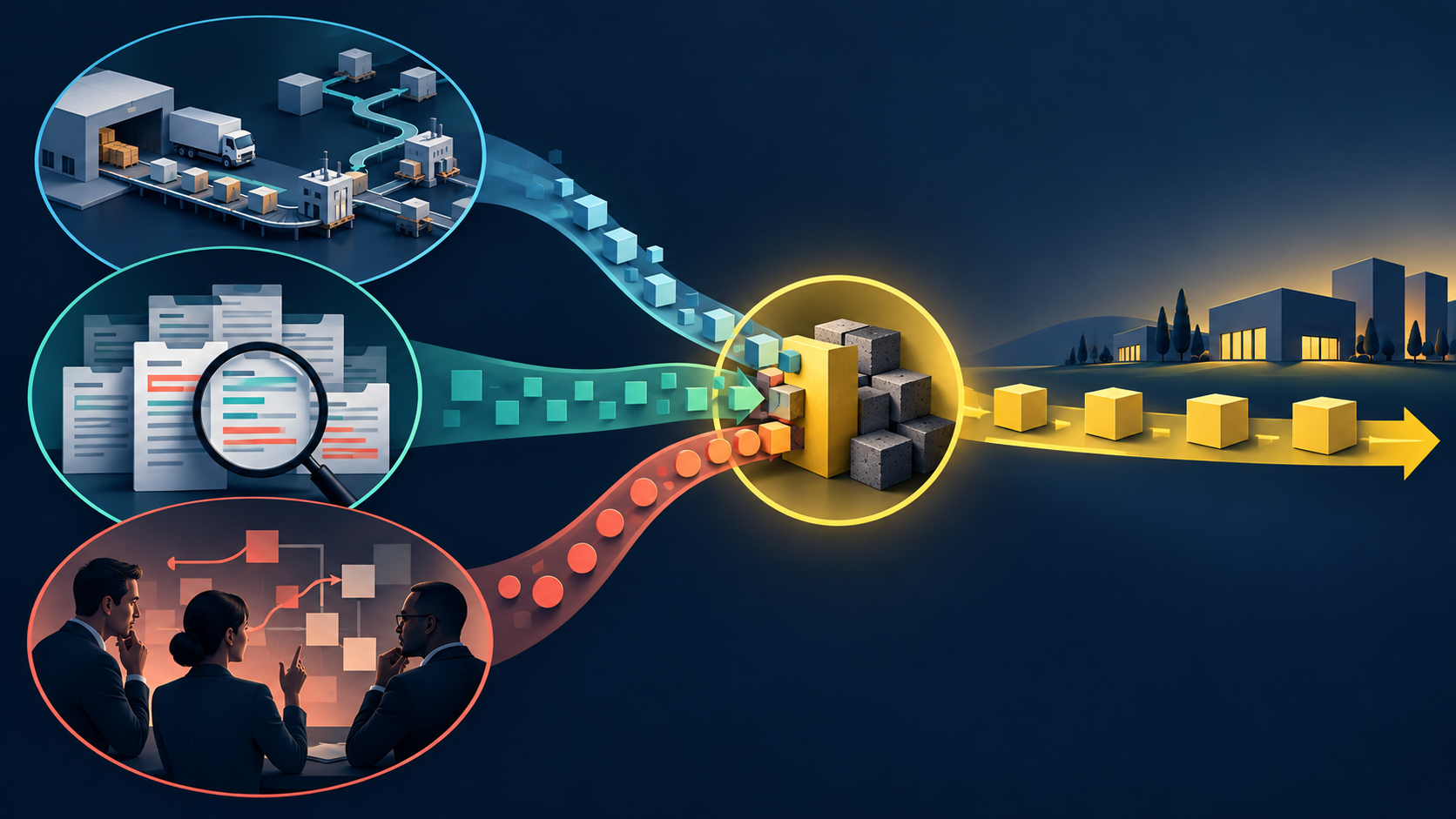
Lemon SYNERGY combines three lenses around one business problem. Each lens tests a different class of explanation.
Scaled agility and flow analysis examine how value moves across teams and functions. The focus is not on adding ceremonies. It is on queues, dependencies, policies, work in progress and the points where delivery loses momentum.
AI-supported evidence review can help organise operational records, compare patterns across sources and surface anomalies worth human investigation. AI does not declare the bottleneck. Evidence quality, confidentiality, context and accountable judgement remain part of the work. This position is consistent with the NIST AI Risk Management Framework, which places trustworthiness considerations across the use and evaluation of AI systems.
Human Leadership and ICF-aligned coaching insight examine what the workflow data cannot explain alone: avoided decisions, unclear ownership, escalation habits or expert dependence reinforced by leadership behaviour. Coaching is used to improve inquiry, ownership and decision clarity. It is not used to label individuals as the problem.
Together, these lenses reduce solution bias. A process issue should not be sold as a coaching issue. A decision-rights problem should not be disguised as a tooling gap. An unsuitable workflow should not be automated merely because automation is available.
What should an initial diagnostic produce?
An initial Product Bottleneck Identification engagement should create decision clarity, not a theatrical audit. Depending on the agreed scope and available evidence, the expected outcomes are:
- a bounded definition of the product or value flow under examination;
- a shared bottleneck statement that separates observed facts from assumptions;
- a view of where work, information and decisions wait;
- a short set of evidence-backed constraint hypotheses;
- a baseline question or signal for evaluating the next change;
- a recommended next step proportionate to the evidence.
The diagnostic should not promise a percentage improvement before the baseline exists. It should make the next investment more defensible and establish what “better” must mean in the client’s context.
Who is this for, and who is it not for?
This work is for executive sponsors and product or delivery leaders who have a material flow problem, access to the relevant people and evidence, and authority to act on what the diagnosis reveals. It is especially relevant in complex or regulated environments where product flow crosses business, technology, risk and operational boundaries.
It is not for an organisation seeking confirmation of a solution already selected. It is not a substitute for a full enterprise audit, detailed technical design or performance management. It also requires a defined problem boundary; “assess everything” is unlikely to produce a decision leaders can use.
Start with the constraint, not another initiative
If your organisation has capable teams yet product outcomes still move slowly, the next investment should begin with evidence. More capacity, stronger tooling or another transformation initiative may eventually be appropriate. First determine what currently limits the system.
Discuss a focused Product Bottleneck Identification engagement with Lemon SYNERGY. We will start with one priority business problem and clarify what must be examined before recommending a larger intervention. Start the conversation.